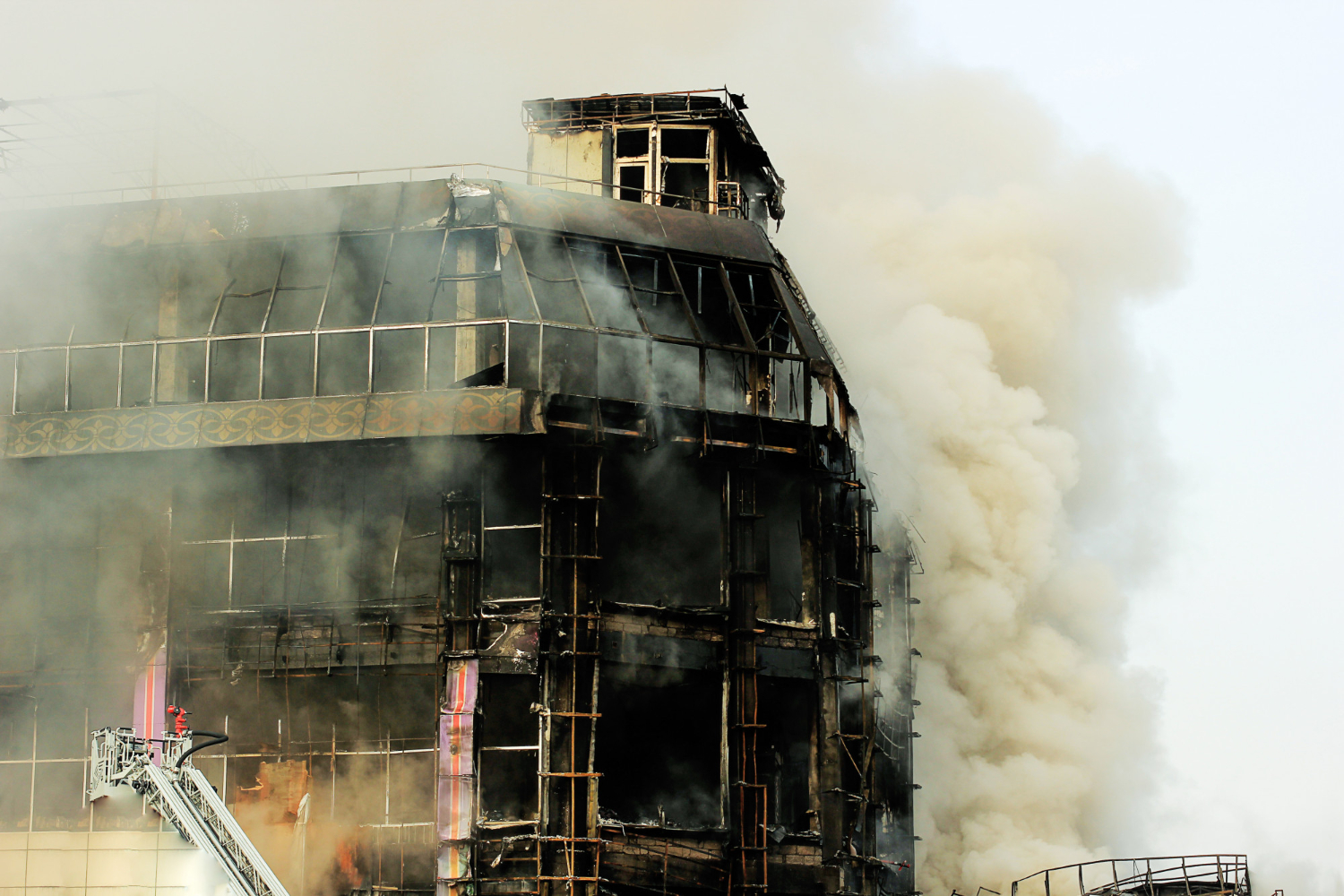
Commercial fire damage restoration is the work of stabilizing a building after a fire, removing smoke residue, soot and firefighting water, and then rebuilding what the fire destroyed. On a commercial property it runs as two linked projects: restoration cleaning that follows the ANSI/IICRC S700 standard, and reconstruction that has to pass permit and inspection before anyone moves back in. Coastal Reconstruction Group handles both under one contract as a commercial general contractor, so the cleaning scope and the rebuild scope are planned together instead of handed between firms.
What does commercial fire damage restoration include?
It includes everything between the fire department releasing the site and the certificate of occupancy: securing the shell, mapping how far residue traveled, cleaning or removing affected materials, drying, odor control, and reconstruction. Smoke and firefighting water can reach far more of the building than the flames did. Smoke moves through return air, plenums, elevator shafts and wall cavities, so a kitchen fire on one floor can leave residue in suites the flames never reached.
The ANSI/IICRC S700 Standard for Professional Fire and Smoke Damage Restoration, published by the Institute of Inspection, Cleaning and Restoration Certification, describes how to assess the presence, intensity and boundaries of fire residues and odors in a building, its HVAC system and its contents. That boundary map is what keeps a scope honest: clean what is affected, leave alone what is not, and document the difference for the carrier.
The commercial fire restoration process, step by step
The work runs in seven stages, and on large or occupied buildings several of them can run at once in different zones.
- Release and safety. Nobody re-enters until the fire marshal or authority having jurisdiction clears the structure. Utilities that serve damaged areas stay off until an electrician and mechanical contractor have looked at them.
- Stabilization. Openings get boarded, roof penetrations get tarped, and the perimeter gets fenced so weather, theft and trespass do not add to the claim.
- Assessment and documentation. The team photographs every room, tests surfaces for residue, records moisture readings and inventories contents before anything is moved.
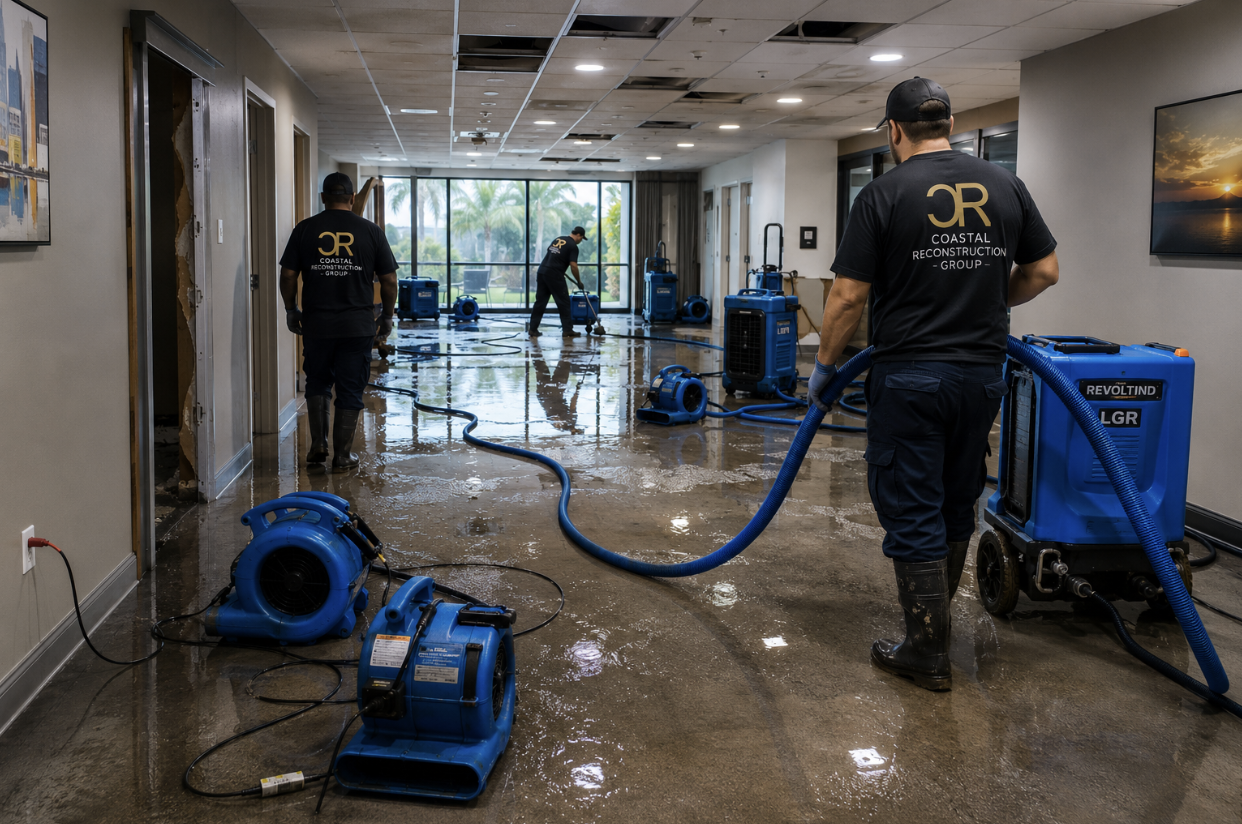
- Water mitigation. Sprinkler and hose water is extracted and the structure is dried, because wet drywall and insulation hidden under soot can turn into a mold problem if they stay damp.
- Source removal and cleaning. Charred and unsalvageable materials come out, then salvageable surfaces are cleaned with methods matched to the residue type.
- Odor management and HVAC. Ductwork, air handlers and plenums are inspected and cleaned or replaced, and odor treatment follows cleaning rather than replacing it.
- Reconstruction and closeout. Framing, drywall, finishes, roofing and building systems are rebuilt to current code, inspected and turned over.
Why does soot keep causing damage after the fire is out?
Fire residue does not simply sit on surfaces, and humidity affects how quickly it can harm them. That combination shapes which areas get cleaned first and how. In Florida and along the Texas coast, high ambient humidity works against the building, which is why drying and residue removal are sequenced ahead of cosmetic work rather than after it.
Residue type also changes the method. Residue left by a fast, hot fire behaves differently from residue left by a slow, smoldering one, so the cleaning approach for each surface is chosen during assessment rather than applied the same way everywhere. Treating a residue with the wrong method can make it harder to remove.
Restoration cleaning vs. reconstruction: who handles the rebuild?
The S700 standard covers fire and smoke cleaning and odor management, and it states plainly that it does not comprehensively address reconstruction. That gap matters on a commercial loss. Once source removal opens up walls, ceilings and roof decks, the project needs a licensed contractor to pull permits, coordinate engineers and trades, and close inspections.
When a cleaning firm and a separate builder split the job, the two estimates can overlap in some places and leave gaps in others, and the project may stall while the second contractor gets started. CRG carries the loss from mitigation through full commercial reconstruction on one schedule, with structural work handled through its structural repair team when fire has weakened framing, joists or decking.
How long does commercial fire restoration take?
Duration depends on square footage, how far smoke traveled, how much material has to be removed, permit review, and how quickly the scope is agreed with the carrier. A contained loss in one suite and a multi-floor loss in an occupied hotel are different projects, and an honest schedule is built only after assessment. Long-lead items such as rooftop units, switchgear, elevator components and storefront glass can set the finish date more than the cleaning does.
Owners can shorten the timeline in practical ways: get the site released and secured early, keep the adjuster involved during the walk-through, approve the restoration work plan quickly, and order long-lead equipment as soon as replacement is confirmed.
How does insurance work on a commercial fire claim?
The carrier decides what the policy covers; the contractor documents the loss and prices the work. Pricing written in Xactimate, a claims estimating platform, lets the carrier and the contractor compare line items directly. CRG prepares its estimates in Xactimate and coordinates with carriers, independent adjusters and third-party administrators, while coverage decisions remain with the carrier. More on that relationship is on the insurance and claims page.
Before work starts, gather the policy declarations, the fire department incident number, photos taken before anything was moved, and a list of business contents and inventory. If the policy carries business interruption coverage, keep payroll and revenue records organized from day one, since those claims rely on documentation rather than estimates. For the wider claim sequence after any disaster, see how the insurance process works for commercial disaster response.
Can a building stay partly open during fire restoration?
Sometimes. If the fire was contained and the authority having jurisdiction allows it, unaffected areas of a hotel, senior living community, medical office or retail center can remain in use while the damaged zone is sealed off. That requires physical containment, negative air pressure in the work area, separate egress paths, and a daily plan for noise, dust and deliveries. This is the same discipline occupied renovations demand, which is why it suits a contractor that phases work around guests, residents and patients. Operators planning that kind of recovery on a property with guests in place can see how CRG approaches hotel construction and restoration.
What should a commercial owner do in the first 48 hours?
Focus on safety, documentation and preventing further loss:
- Stay out until fire officials clear the building, and keep tenants and staff out too.
- Notify the carrier or broker and record the claim number.
- Photograph and video every affected area before cleanup starts.
- Have the building secured against weather and entry.
- Do not wipe soot, run the HVAC system or turn on damaged electrical circuits.
- Move tenants, residents or operations only as far as safety and the authority having jurisdiction require.
The fire damage restoration service page lists what CRG's scope covers from stabilization onward, and the Rapid Response Program explains how property teams can set up an emergency relationship before they need one.
Next steps
For a property dealing with an active fire or smoke loss, the 24/7 emergency line is (866) 630-5157. For planning conversations about a portfolio, a pre-loss agreement or a damaged property that is already stabilized, reach out to CRG and the scope can be reviewed with your property team and adjuster.
Frequently asked questions
Can smoke odor be removed completely?
In many buildings, yes, but only after the residue that causes the odor is cleaned or removed. Deodorizing without removing that residue first may only cover the smell for a while. Porous materials such as insulation, ceiling tile and some carpet are often replaced because cleaning them cannot reliably remove embedded residue.
Is fire damage restoration different for commercial and residential buildings?
The cleaning science is similar, but commercial losses add building systems such as large HVAC networks, fire alarm and sprinkler systems, elevators and commercial kitchens, plus tenant leases, business interruption claims and permit-driven reconstruction. Planning the schedule around occupants and day to day operations sets commercial work apart.
Does the HVAC system need cleaning after a small fire?
Often, because air handlers can draw smoke through return ducts and spread residue far from the fire. The S700 standard includes HVAC systems in the assessment of where residues traveled. Running the system before it is inspected can redistribute soot into clean areas.
Which states does Coastal Reconstruction Group serve for fire restoration?
CRG works primarily in Florida, Georgia, Alabama, South Carolina, North Carolina and Texas, and is licensed in 32+ states. Its headquarters is in Longwood, Florida, with a regional presence in Texas, so commercial fire restoration crews mobilize from both states.